Written by Martin Banks
A Chinese invasion of Taiwan would “trigger a global catastrophe”, according to Taiwan’s ambassador to the EU and Belgium.
Ambassador Shieh Jhy-wey said such an event would come with “economic, technological, geopolitical, and human fallout far exceeding the impacts of the COVID-19 pandemic or the 2008 financial crisis.”
Speaking in Brussels last Wednesday, the diplomat cited figures from the Bloomberg Economics research service that he said spell out the overall financial cost of a “full-scale war” over Taiwan.
He said it shows the cost of any conflict would amount to some $10 trillion to $10.6 trillion, “shaving off roughly 10% from the global GDP in the first year alone.”
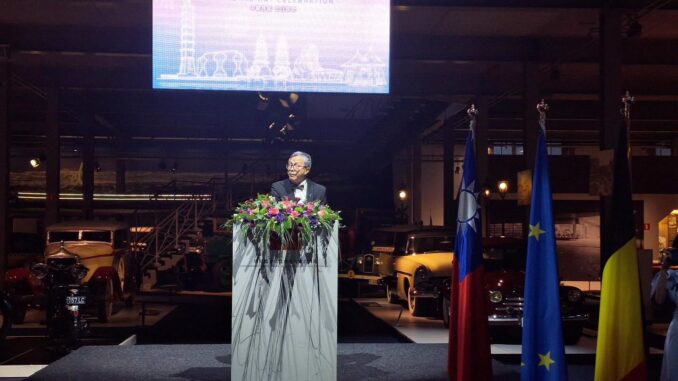
The ambassador, who took up his post in Brussels just over one year ago, was addressing a packed audience to mark the 115th National Day of ROC Taiwan.
He started a particularly strongly-worded speech by welcoming those present he said were from the Chinese Movement for Freedom and Democracy!, plus Tibetans, Uigurs and Hongkongers.
He said they were “representing their people fighting for their country, their hometown and their freedom all over the world.”
He hailed Taiwan’s “achievement as a vibrant democracy,” adding, “even as we stand firm against decades of unrelenting external pressure from the Communist China.”
This, he said, ranged from “hybrid military drill and maneuvers, cyberattack, undersea cable sabotage, fake news and all kinds of violent intimidation, international isolation and comprehensive strangulation.”
He added, “Altogether, It´s a part of grey zone strategy. On the one hand, they appeal to our sense of family but, on the other, embrace us tightly.”
His comments will be hotly contested by China which sees self-ruled Taiwan as a breakaway province that will eventually be under Beijing’s control – and has not ruled out the use of force to take the island.
Beijing asserts that Taiwan has belonged to China since ancient times, referencing dynastic history and post-World War II declarations that returned Taiwan from Japanese control to Chinese sovereignty.
Today, only 12 countries (plus the Vatican) officially recognise Taiwan.
Much of the world’s electronics – from phones to electric cars – are powered by computer chips made in Taiwan and it is widely agreed that any conflict between the two sides would devastate global semiconductor supply chains, with severe economic consequences globally.
China continues to claim sovereignty over the island of Taiwan and President Xi Jinping’s stated objective is of “re-unification” by 2049.
The Taiwan ambassador, in his address, told an audience numbering over 350 that on his way to the event he was contacted by a journalist “who wanted to know where was Taiwan by the meeting between President Trump and President Xi last week.”
The ambassador was asked, “Was Taiwan on the menu, if not at the table?”
“I answered: Taiwan was not at the table, that´s for sure, yet it wasn’ t on the menu either.
“Where was Taiwan then? He insisted to know.”
In his annual national day speech, he said, “I said, Taiwan was in the kitchen, as one of the most significant suppliers, holding the key position in the Indo-Pacific Strategic Alliance.”
He reminded the audience that out of every second container that passes through the Taiwan Strait, an estimated 80 percent of highly advanced chips are produced and delivered by the Taiwanese semiconductor industry.
He asked what could be done to prevent the “catastrophe” he says would follow if China invaded Taiwan.
He said, “Deterrence is the key word.”
He said sending warships to pass the Taiwan Strait would sent “a strong signal” to Beijing that the Taiwan Strait is a part of international waters.
He went on, “After seven years disconnection from the EU, the Chinese have come back to the EU now and is trying to make a win-win-promise again. But, from lessons you in the West and we Taiwanese have learned from the past dealing with the CCP, they are going to blackmail, threaten and intimidate you and ask you to terminate every contact with Taiwan.”
“Under certain circumstances, some could even start to hesitate or doubt their relationship with Taiwan.”
Here he quoted Shakespeare, saying, “Pay attention to what one of the roles in ´Measure For Measure´ says: “Our doubts are traitors, and make us lose the good we oft might win, by fearing to attempt.”
“Yes, China is expecting you to get rid of Taiwan from your circle of friends. And it has been trying to exclude Taiwan from every international society and from organizations like the United Nations. According to China, Taiwan should not be seen and should not be heard.”
He said, “One of the first steps is that Taiwan is not allowed to use the name Taiwan. So we are forced to use the name ´Taipei representative office in EU and Belgium.”
He said asking China to accept the name ´Taiwan Mission´ was “mission impossible”.
He recalled that “thirty years ago, Taiwan accomplished something great and unforgettable which had been regarded a mission impossible for decades.
“In 1996 the Taiwanese people elected our president and vice president in free, direct and democratically but since then, neither the president nor the vice-president could visit Europe, not even as tourist.
“But last November, our vice -president Shiao Bi-Qin was invited by the IPAC to deliver a keynote speech in the European Parliament.
“China was, of course, furious and protested and protested.”
Further comment came from German EPP MEP Michael Gahler, Chair of the European Parliament’s Taiwan Friendship Group, who said Taiwan was a “reliable and democratic” partner to the EU and was committed to a “rules based order.”
China’s “military pressure” against its neighbour across the Taiwan Strait was “intense” but he also stressed the importance of “dialogue”.
He also noted the EU had resumed parliamentary visits to China although this, he added, “does not change our policy.”
